
 British businessman Richard Branson and U.K. Deputy Prime Minister Nick Clegg have advocated for drug policy reform in the past. But experts say their op-ed calling on the U.K. to end the war on drugs, published Tuesday in The Guardian, is especially noteworthy as British elections near. British businessman Richard Branson and U.K. Deputy Prime Minister Nick Clegg have advocated for drug policy reform in the past. But experts say their op-ed calling on the U.K. to end the war on drugs, published Tuesday in The Guardian, is especially noteworthy as British elections near."Doing this in advance of the election is symbolically important," Ethan Nadelmann, executive director of the Drug Policy Alliance, told The Huffington Post. "It's rare for such a significant party to take such a bold stance on drug policy." Branson, founder of the Virgin Group, and Clegg, a Liberal Democrat who has been deputy prime minister since 2010, argue in their article that the country's prohibitionist approach to drug use has failed, and its residents would be better served by policies that emphasize treatment instead of punishment. "As an investment, the war on drugs has failed to deliver any returns," they write, pointing to a growing criminal market, rising incarceration rates of "people whose only crime is the possession of a substance to which they are addicted," and no meaningful reduction in drug use across Britain's population. "If it were a business, it would have been shut down a long time ago. This is not what success looks like." Polls suggest that Clegg's party stands little chance of victory in Britain's general election on May 7. But Nadelmann noted that Clegg's longtime support of drug policy reform has already helped to change the discourse. And now that Clegg is taking a firmer stance, it will likely become a key issue for the Liberal Democrats. "His commitment to the issue and his outspokenness has helped legitimize the drug policy reform perspective in British politics," Nadelmann said. Over the past several years, he said, even conservative publications like the Daily Mail have begun to shift the tone of their drug coverage. "The tabloids have evolved from being knee-jerk drug war proponents to having significantly more moderated views," he said.  The United States officially declared "war on drugs" in 1971 under President Richard Nixon. According to Nadelmann, the U.K. began adopting its harshest policies a decade later, during the Margaret Thatcher administration. Now, as Clegg and Branson write, "the west is undergoing a tectonic shift; and the U.K. seems oblivious to it." They cite legalization of recreational marijuana in four U.S. states, along with decriminalization and harm-reduction efforts in Portugal, the Netherlands, Spain, Switzerland, the Czech Republic and Denmark, as proof that their country lags behind. Since Portugal introduced one of the world's most sweeping decriminalization efforts in 2001, teenage drug use, drug-induced deaths and HIV/AIDS rates have declined, while the number of individuals receiving treatment for addiction has increased. "The Portuguese system works, and on an issue as important as this, where lives are at stake, governments cannot afford to ignore the evidence," Branson and Clegg write. "We should set up pilots to test and develop a British version of the Portuguese model." A recent Guardian poll found that 84 percent of Britons think the war on drugs can't be won and that 88 percent think marijuana should be either legalized or decriminalized. Sixty-one percent of respondents, however, answered "no" when asked if "certain drugs that are currently illegal" should be legalized or decriminalized. Meanwhile, a new political group that calls itself the Cannabis Is Safer Than Alcohol party plans to use the U.K.'s general election to advocate for marijuana reform. Clegg and Branson didn't go so far as to say Britain should legalize drugs as well as decriminalize them. Nadelmann said this tactic may work in their favor. "When someone advocates for full-scale legalization, it tends to distract attention from more important and realistic incremental reforms," Nadelmann explained. For him, meaningful reform includes ending marijuana prohibition, reducing incarceration rates and emphasizing treatment over criminalization. The position of Branson and Clegg "reflects the more nuanced and sophisticated drug policy dialogue that has evolved," he said. |
Top Brits Call On The U.K. To Decriminalize Drugs
Safety for Women and Girls: Protection Strategies for a Healthful World

| This International Women's Day, as we step back to marvel at the significant progress made by women and girls worldwide, we take note as well of the distance yet to travel before every woman and girl feels safe in this world -- safe enough simply to go to school, to gather water or firewood, to go to work before dawn. Safe enough that you know you can deliver your baby at a health facility without complications, or that you can take her there for her inoculations, without worrying about being exposed to the Ebola virus or to some other health hazard. Safety is not linear; to ensure that a clinic can cope with a medical emergency such as the Ebola crisis and continue to handle routine care requires substantial strengthening of an entire health system. To do so includes fortifying both the supportive care net of safe hydration, safe blood, safe medicines, safe heating and cooking technologies, and training cadres of community health workers and public health nurses who, as frontline caregivers, can attend to their communities while remaining alert to instances of contaminated groundwater, disease or a high-risk pregnancy. So easily come the words, "safe enough simply to go to school." But safety is not a simple thing, nor are we necessarily making progress. Just last month the United Nations Human Rights Council reported that, "attacks against girls accessing education persist and, alarmingly, appear in some countries to be occurring with increased regularly." This is as true in our own hemisphere as in Nigeria, Pakistan and other places that have sadly earned notoriety for such attacks: in Central America, the Human Rights Council reported, the incidence of threats, harassment and sexual violence inflicted by criminal gangs on schoolgirls has compelled many of them to give up on their dreams of an education. The Ebola crisis has kept hundreds of thousands of adolescent girls out of school in the afflicted countries, interrupting their education and rendering them more vulnerable to rape and to other forms of abuse. And the Syrian war has forced roughly four million Syrians from their homes, at least half of them women, and half under 18, into foreign countries where gender protections can be weak at best and where the children have by now lost years of schooling. Each day these displaced girls and women must further endanger their and their families' lives by venturing out to collect the bits of wood, piping and plastic that they then burn indoors, to cook their food amid the toxic fumes. Even in peaceful settings it is not a simple proposition to ensure that a woman or girl can retrieve water or wood without risking sexual assault. Doing so would require sufficient funding simply to clear overgrown pathways, move potable water points closer to households and champion such safe and fuel-efficient technologies as solar street lighting and clean cook stoves. These solutions, although involving multiple steps, are neither costly nor impossible; why are they not more widely embraced? At a young women's forum in the crowded Nima settlement in Accra, Ghana, the Millennium Cities Initiative and our partner youth organization Voice in Community Empowerment confirmed that the dearth of streetlights was a chronic impediment to girls' education and to women's working lives. Working together, with very little money, MCI, VOiCE and the young women themselves organized the community to put up its own streetlights. Across the continent, in Kisumu, Kenya, women participating in WomenStrong's savings and loan groups are using their enhanced income to buy clean cook stoves, sparing them both the indoor pollution and the dangerous daily hunt for wood. These modest investments have been made by ordinary citizens, requiring neither rocket science, high diplomacy or big bucks to carry out. Some changes do require higher-level leadership. The seemingly mundane routine of sending one's daughter off to school in the morning actually requires prescient public investments in safe transport, safe schoolyards and buildings, and in training caring, responsible educators committed to treating their students with the attention they would lavish on their own children. MCI has worked to convene all levels of government, NGOs and community-based organizations in adopting this integrated approach to solving such civic problems as getting all children safely to school and home. Despite our knowing what needs to be done, and knowing it can be done affordably, tragedies continue to happen, every day. Members of our WomenStrong girls' clubs in Kisumu regularly report having undergone sexual attacks on their way home from school or while doing their families' evening shopping. This horrific reality cannot remain the status quo. WomenStrong and our partners have provided counseling and legal support, and for years MCI has helped the girls and mothers advocate for well-lit streets and kiosks, expanded bus routes and more frequent buses; the wider community now needs to join these girls and women in making their city streets safe. We must change this dynamic, with smart investments designed to end this global disregard for women's and girls' safety. Engineers, nurses, teachers, political leaders, international donors: it's on you, in 2015, to keep women and girls safe. President and Mrs. Obama have stepped up, with their ambitious new "Let Girls Learn" initiative, which will surely increase the spotlight on this issue. Taking a cue from the First Lady, it's now on us women and girls, to become those engineers, nurses, teachers and politicians who can make this happen, and to speak up, this International Women's Day and every day, on behalf, simply, of safety for women and girls and communities, everywhere. |
Arm the Peshmerga Directly, Provide Support for Refugees

House Resolution 5747, a bipartisan bill giving President Obama the temporary authority to directly arm the Kurdish Peshmerga in their fight against ISIL, is circulating in Congressional offices, gaining more and more support amongst members of the U.S. Congress. Recent visits to Erbil by U.S. Senator Bob Corker (R-TN), the chairman of the Foreign Relations Senate Committee, and Senators John McCain (R-AZ) and Jack Reed (D-RI), chair and ranking member of the Armed Service Committee, will surely help this process on the Hill.
Quite rightly so, since the Kurds and the Kurdistan Regional Government have been a strong U.S. ally and friend since long before ISIL emerged. The Kurdish Peshmerga is a primary force in fighting ISIL and holds a thousand-mile border with the terrorist group. Their need for more advanced weaponry and heavy artillery is dire. Fighting such a brutal enemy that continually shocks the entire world with its despicable killings and beheadings, an enemy that disregards any rules of military engagement, with outdated AK47 rifles is unacceptable. Not that military aid is not reaching the Kurdistan region, but problems in coordination are still present. There are still some political forces in the federal government in Baghdad trying to hamper the notable progress made in December, when negotiations between the Baghdad government and the Kurdistan Regional Government in Erbil over the 2015 budget and oil export issues were successful. As an example of these pockets of political obstructionism in Baghdad, recently the United States sent 220 armored vehicles to Iraq, out of which only 13 reached Kurdistan's Peshmerga units on the front lines. That is why the U.S. Congress's initiative to allow the U.S. to directly arm the Peshmerga is vital. Such an act will also help political processes in Iraq, sending a clear and strong message to all political groups that genuine inclusion, compromise and effective implementation of agreed steps in creating a just future for every ethnic group in this war-torn country must be honored. At present, civil servants working in the Kurdistan Regional Government have not received their salaries for several months. Payments to the Peshmerga forces are late too. International companies that were engaged in a number of capital projects in the Kurdistan region could not receive payments for their work, nor could they pay their various subcontractors. Some corrupted powerful political factions in Baghdad are simply preventing the flow of money to Kurdistan, trying to arrest their evident progress. But by suppressing cash flow to Erbil, Baghdad is also trying to turn away international investors, companies and service providers that are operating well in Kurdistan. Haider al-Abadi, the new Iraqi prime minister, and his cabinet will have to be very effective in stopping this malicious practice. New Refugee Crises in Kurdistan on the Horizon With preparations well on their way for the operation to liberate Mosul, Iraq's second-largest city of two million, a new refugee crisis is on the horizon. So far, Kurdistan is host to two million refugees, both internally displaced persons from inside the country and also from Syria. The entire Christian and Yezidi refugee communities have found a safe haven in Kurdistan. It is clear that the battle for Mosul will produce yet another wave of refugees that will no doubt come to the Kurdistan region. A number of international NGOs are present in Kurdistan and are working hard to help absorb the growing needs of the population there. 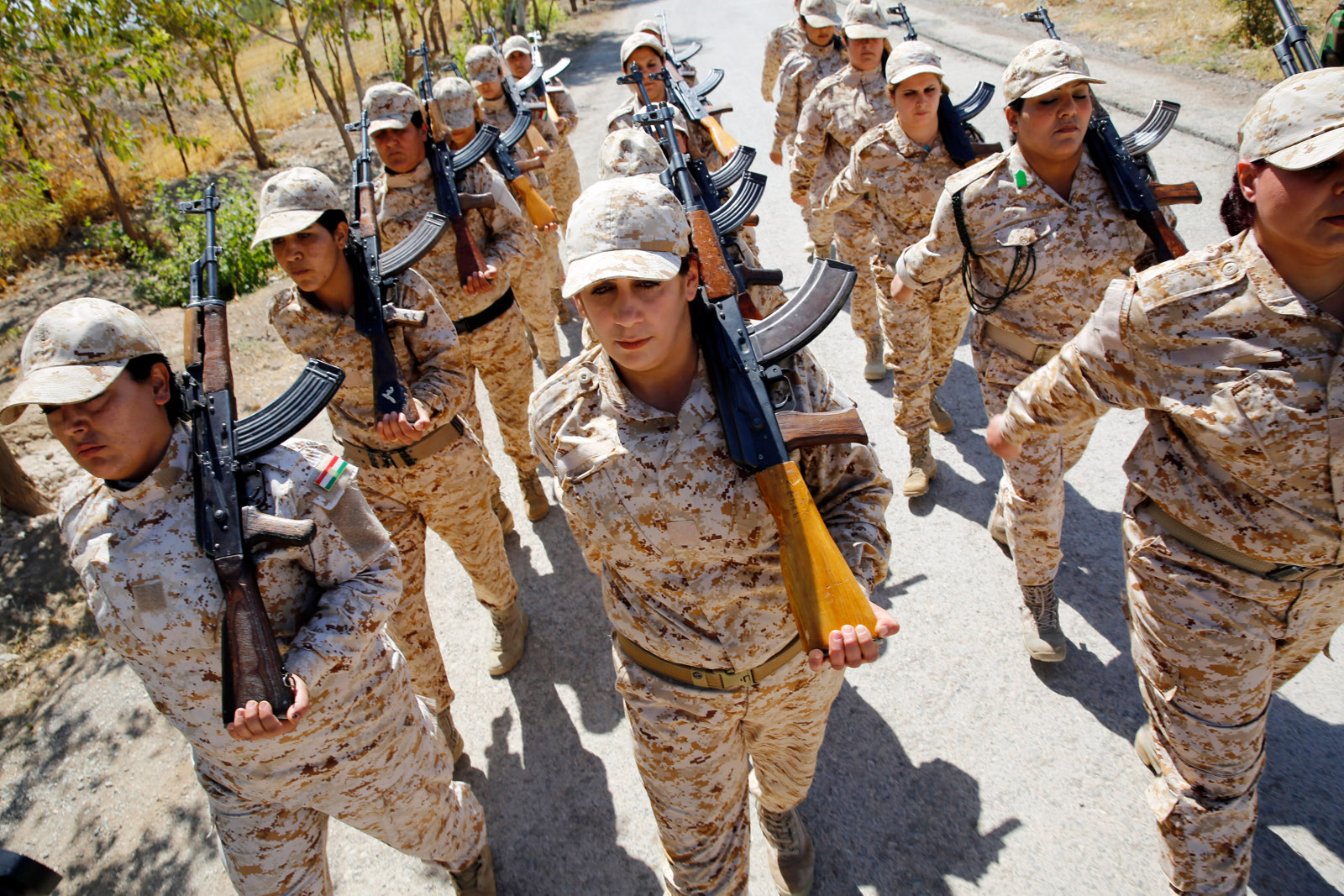 (Ahmed Jadallah/Reuters) Barzani Charity Foundation to Open Branch in the United States The Barzani Charity Foundation was founded in 2005 and operates without governmental or political party financial support, financed entirely through private donations. The Foundation's role model, inspiring the involvement of a number of local community volunteers to contribute to the effort, is the legacy of Mullah Mustafa Barzani, a most prominent political figure in modern Kurdish politics and a leader of the Kurdish liberation movement. It will open an office in Washington D.C. seeking more support for the refugees. Mullah Mustafa Barzani was born in 1903 and passed away in 1979. He was the father of the current president of Kurdistan, Massoud Barzani. The foundation that bears Mullah Barzani's name provides food and shelter for refugees both domestic and international (about 95 percent of Syrian refugees in Kurdistan -- roughly 220,000 people -- have been placed in the Dohuk governorate in Kurdistan). It has six communal food kitchens preparing daily meals for over 150,000 refugees from the Shangal area. The foundation also provides scholarships in support of youth education and also has an Orphan Sponsorship Program for children who have lost their parents. Plan To Rebuild Kobane The Syrian Kurdish city of Kobane, bordering Turkey, stands now as an inspirational symbol of resistance to ISIL. After months of fighting, the city was liberated on January 26 this year. Kurdish women formed Peshmerga military units and fought shoulder to shoulder with Kurdish men, and emotional pictures of women with bombs, rifles and anti-tank launchers confronting ISIL flooded the world. The Barzani Charity Foundation is making plans to help rebuild Kobane and restore life in that devastated city. Kobane should remind us all of the danger that ISIL poses to the entire civilized world. We owe it to the people of that city, and the courageous efforts of the Kurdish Peshmerga who freed it, to ensure that they are receiving as much support as we can offer. |
Langganan:
Komentar (Atom)


