
 San Francisco is on track to reach a major milestone in its fight against homelessness, according to its mayor. San Francisco is on track to reach a major milestone in its fight against homelessness, according to its mayor.During a stop at the city's veterans memorial on Wednesday, Ed Lee announced the Golden Gate City would house all of its chronically homeless veterans this year "by committing the resources necessary," the San Francisco Chronicle reported. According to the news outlet, the city -- through partnerships with federal agencies and nonprofits -- has placed about 500 chronically homeless veterans into stable housing since 2013. San Francisco has used both city and federal funding to put roofs over vets' heads, like renovating the former Stanford Hotel to accommodate 130 homeless people. Lee's announcement comes amidst a nationwide prioritization among cities to find housing for every veteran who's struggled to find stable shelter. On Monday, first lady Michelle Obama praised New Orleans for becoming the country's first major city to achieve the feat last December, and -- despite experiencing record-highs of overall homelessness in recent months -- the Big Apple could end the crisis among veterans in 2015, too, according to Mayor Bill de Blasio. "Those who fight abroad to protect our freedom should never be left without a home here in the country they defended," De Blasio said in February, the Gotham Gazette reported. "It makes no sense, and we won't let it happen." The U.S. has made considerable progress on the issue under President Obama, according to the White House. Between 2009 and January 2014, veteran homelessness dropped 33 percent, including a 42 percent reduction in veterans who were living unsheltered (as opposed to staying in impermanent housing conditions, such as shelters). Although San Francisco is expecting to win its war against veteran homelessness, the city counted 6,436 homeless people in total in its latest survey -- a figure that has remained relatively unchanged since at least 2005. Gary Kamiya, executive editor of San Francisco magazine, wrote about the city's longstanding struggle to curb homelessness in a recent article for San Francisco magazine. "Even as the city undergoes another of its seismic transformations, with new skyscrapers piercing the horizon, gleaming apartment buildings popping up every month, and startup companies sprouting from every crack and corner like sour grass," he wrote in the magazine's March issue. "One thing has not changed about its landscape: The homeless." To help fight homelessness, support PATH (People Assisting The Homeless) by using the Crowdrise widget below. Fundraising Websites - Crowdrise |
Healthy Living - San Francisco Will End Chronic Vet Homelessness This Year: Mayor
Police Throw Rocks Back At Protesters In Baltimore
Baltimore police officers targeted by rock-throwing protesters on Monday appeared to hurl projectiles toward crowds on at least two occasions.
One photo shows a projectile, possibly a rock or piece of concrete, leaving an officer's hand.  (AP Photo/Patrick Semansky) Video taken from a helicopter appears to show another officer hurling objects toward protesters, including many who appeared to be teenagers. At least seven officers were injured Monday as protesters launched rocks, bricks and other objects at police. Some of the projectiles were reportedly heavy enough to break police riot shields. Baltimore police Capt. Eric Kowalczyk said one of the officers who had been hit was "unresponsive," and others had "broken bones." Kowalczyk suggested police would deploy traditional riot-dispersing tools. "You're gonna see tear gas, you're gonna see pepper balls," he said. Police didn't immediately answer a request for comment about the photos of officers throwing projectiles. On Monday morning, mourners gathered for the funeral of 25-year-old Freddie Gray, who sustained a fatal spinal injury in Baltimore Police custody earlier this month. He was arrested for running away from officers, and was placed in the back of a police van without a seatbelt, a violation of department policy. Video of his arrest and questions about his death had led to multiple rounds of mostly peaceful protests throughout the city before Monday. |
Emi Mamiya Allegedly Stabs Husband Over Bathroom Stink: Report

This situation stinks for everyone involved.
Emi Mamiya, 29, allegedly said her husband went to the bathroom and left an intolerably bad smell behind on the afternoon of April 12, according to Japanese wire service Jiji Press. She also said the 34-year-old man then tried to help their 3-year-old use the toilet "without washing his own hands first," Agence France Presse reports. According to TBS News, Mamiya became enraged and attacked the victim with a knife, leaving a 7-inch gash in his left cheek. Officers from the Tokyo Metropolitan Police arrested Mamiya at the scene. She denies that she tried to kill her husband. |
This Controversial Chinese Company Wants To 3-D Print Your Next House
SUZHOU, China -- Walking through WinSun's show lot in the Suzhou Industrial Park, one gets a glimpse of the past and possible future of building construction. Views from the fifth story of a boxy concrete structure reveal a horizon typical of the outskirts of Chinese cities today: Clusters of construction cranes surround high rises sprouting from rice fields.
Streams of trucks flow to and from these construction sites, carrying in the raw ingredients of China's construction industry -- migrant workers, steel and lots of cement -- and departing with loads of wood scraps and building waste. It's a model that has fueled the largest urbanization and housing boom in history, while also helping pollute China's skies and deplete its natural resources. 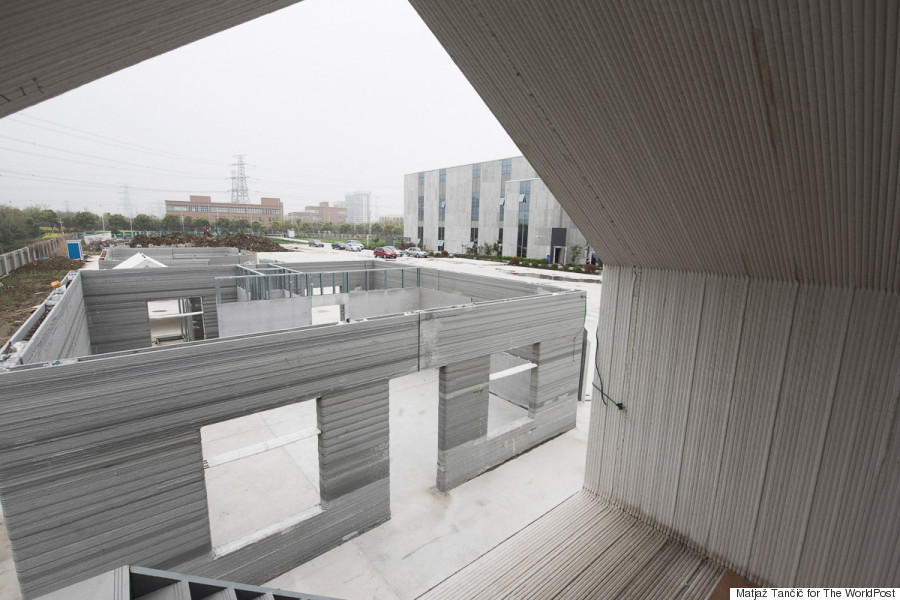 WinSun (Chinese name: Yingchuang) says it wants to overturn that model. That boxy concrete structure isn't made of the usual blend of ingredients. It was 3-D printed inside WinSun's factory, using a machine that turns construction waste and digital designs into precisely layered walls. That's a production model that could upend labor markets, housing markets and the entire architectural design process. Or it could be a gimmick, a publicity ploy based on stolen technology with no real chance of working in the real world. At this point it's hard to tell for sure, and that's part of what makes the emerging world of buildings printed in 3-D so fascinating. WinSun's 3-D printed structures have attracted equal parts buzz and controversy. The company advertises itself as the breakout innovator in a field that will dramatically reduce building waste and labor inputs. But the academic credited as the founding father of this field says WinSun infringed on his patents, stealing innovative techniques that took him decades to formulate. Developers, architects and researchers remain similarly divided over whether 3-D printed houses are safe, affordable or even desirable. 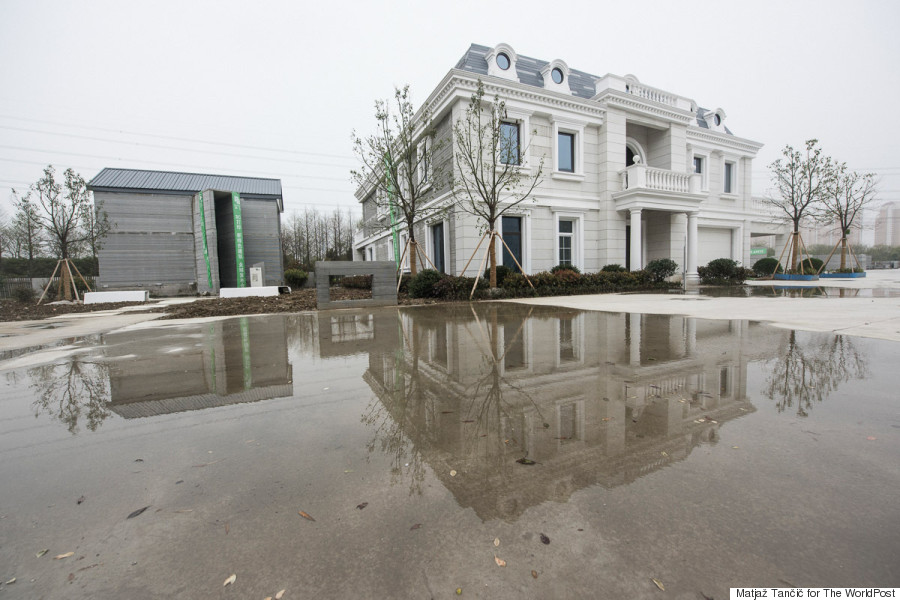 The company at the center of the controversy got its start as a supplier of construction materials, but made international headlines last year when it unveiled 10 small houses in Shanghai that it had printed in its factory. In 3-D printing (also known as additive manufacturing) objects are built up layer by layer. A 3-D printer intakes a digital design, and then a moving nozzle deposits successive layers of fast-hardening liquid, with each layer drying before the next layer is set down. 3-D printing allows for greater flexibility in the design and prototyping process, but is usually slower and and more expensive than mass production using molds. WinSun took the basic concept behind 3-D printing and applied it on a much larger scale, using a cement-like mix of construction waste as the liquid. Structures standing in the WinSun lot bear enlarged hallmarks of 3-D printing -- the walls are composed of hundreds of stacked layers, each about an inch thick and rough to the touch. WinSun says it could smooth out the layers but maintains their original outline to demonstrate the technology. 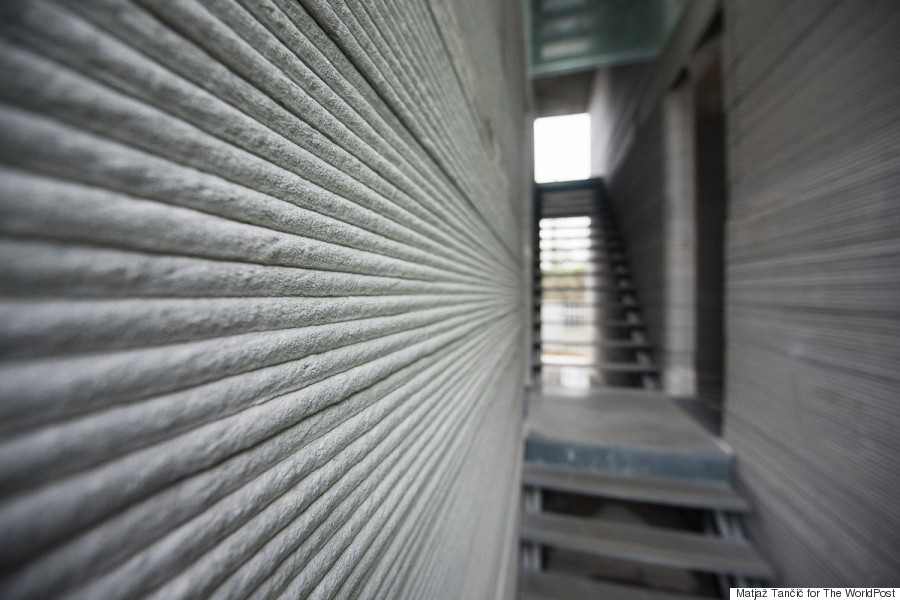 Clusters of empty and roofless structures abut a more polished mansion with some bare bones furnishings inside. WinSun says the mansion's five-story neighbor is the tallest building ever produced by a 3-D printer, but it has a 100-meter-high tower in the works. The company says it has already secured orders for its machines from clients in several countries, including a firm that hopes to print out 20,000 affordable houses for the Egyptian government. WinSun won't divulge the names of its clients, but one employee claimed that the relative of a Saudi prince toured the facilities and was considering ordering a mansion. In marketing its technology, WinSun emphasizes the environmental benefits of reductions in construction materials (30 to 60 percent, according to some estimates). WinSun CEO Ma Yihe says that in the coming years the company will build "dream factories" around the world, using sand and other construction waste as the main ingredients in its liquid. Ma says WinSun has already begun construction on a handful of factories in China and one in Dubai. "We'll use local materials, build locally and sell locally," Ma told The WorldPost. 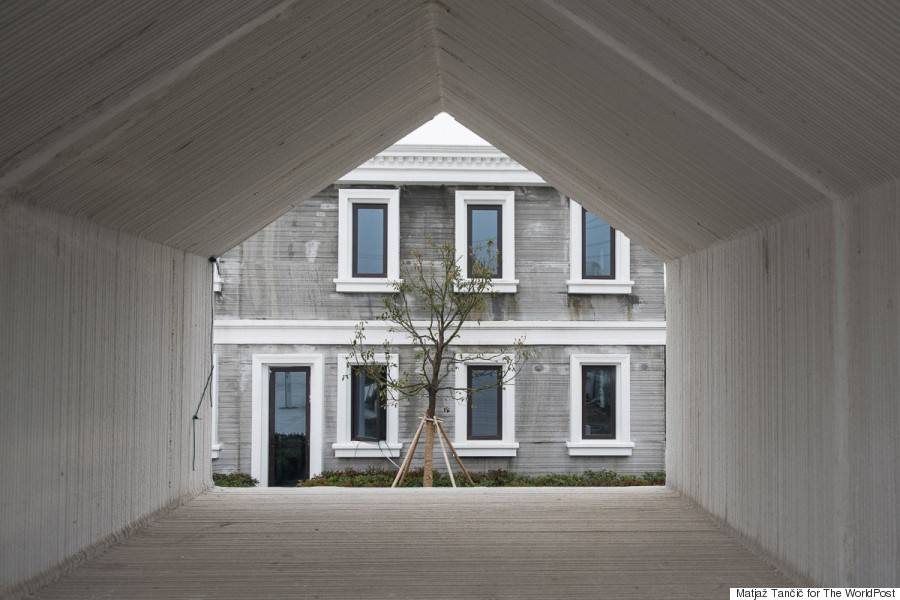 Most appealing to Chinese developers is the labor-saving nature of the machines. After three decades in which China's number of migrant laborers reached into the hundreds of millions, recent labor shortages have led to wage hikes. On a recent Friday, Xu Feng, a real estate developer from a neighboring province, wandered the WinSun lot, asking for cost specifications and taking pictures with his iPad. "Right now the biggest problem in real estate is migrant workers," Xu told The WorldPost. "If this can replace migrant workers, then it'll definitely be the trend of the future. Absolutely." According to WinSun, the company's 3-D printer is 150 meters long, 10 meters wide and 6.6 meters tall. It can allegedly crank out at least one story of a building each day, and these component pieces are then assembled and stacked on site. WinSun doesn't allow anyone to view its machine or production processes, citing concerns over intellectual property. 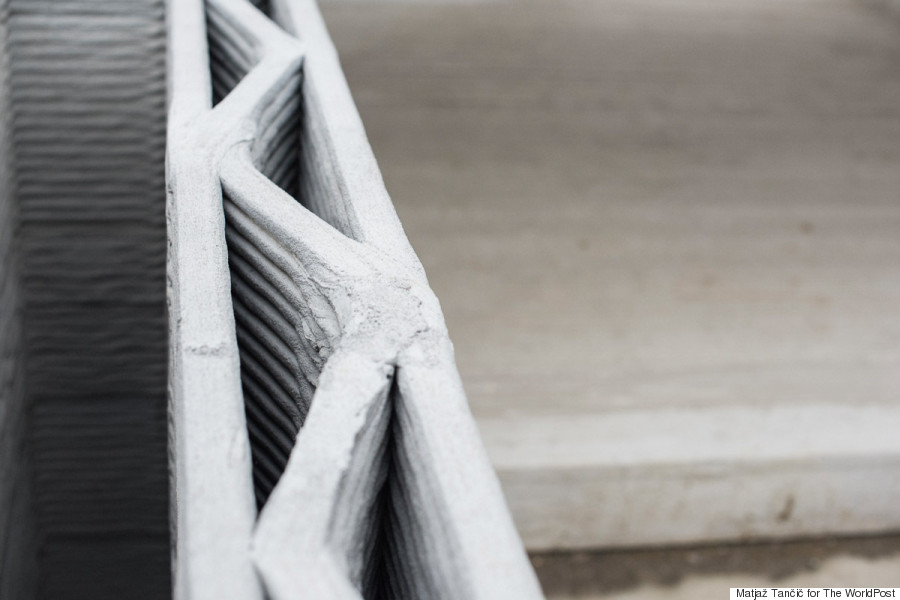 Those are precautions Dr. Behrokh Khoshnevis didn't take. Khoshnevis, a professor at the University of Southern California, pioneered a 3-D printing technique for concrete known as Contour Crafting. That technique recently won a major award from NASA, and based on video recordings, it appears strikingly similar to techniques employed by WinSun. The similarity is no accident, according to Khoshnevis. "WinSun basically copied my patents, infringed on my patents," Khoshnevis told The WorldPost. Khoshnevis says WinSun's CEO approached him in 2013, offering to act as a materials supplier for Khoshnevis' project. Ma visited Khoshnevis' Los Angeles workshop and Khoshnevis saw Ma's company in China. "He showed me materials and asked me to show him the consistency and all that," says Khoshnevis. "I showed him a lot of things thinking he was going to supply material." Khoshnevis remains indignant about the incident, but says he isn't pursuing legal action because he believes his technology is years ahead of his rival's. He believes his technology holds massive promise for affordable housing, post-disaster relief and even space colonization. 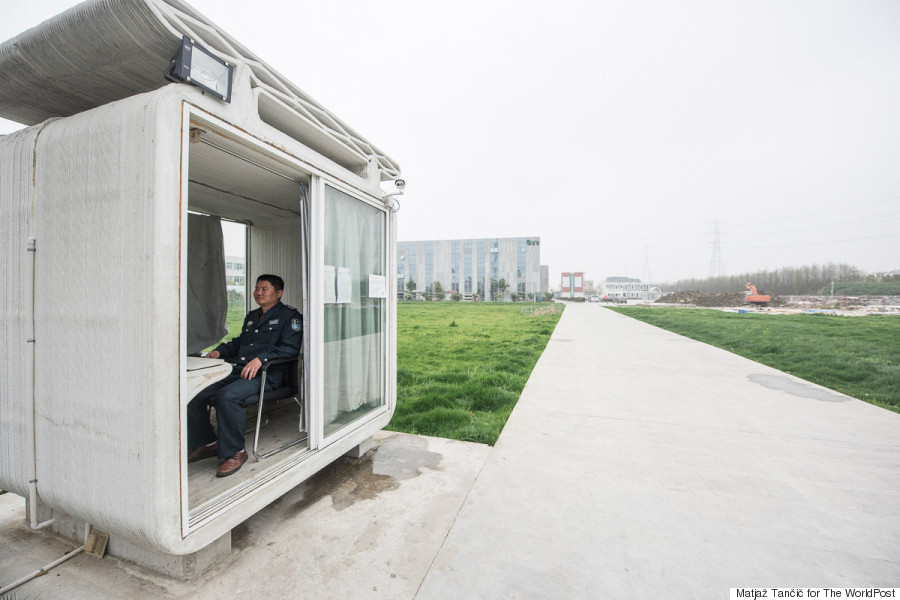 WinSun's CEO says Khoshnevis isn't pursuing legal action because he has no basis for his claims. Ma says WinSun developed the crucial liquid entirely on its own, and points out that Khoshnevis and his team have yet to build a complete structure. "I don't know what kind of intellectual property he has and I don't really understand the things he's done because there isn't anything there," Ma told The WorldPost. "What does he have that we could look at? Nothing. What does he have that we could learn from? Nothing. Even if we wanted to learn from his stuff, there'd be no way for us to learn." Khoshnevis says he has been working on Contour Crafting for 20 years, and he claims that he could have produced WinSun-like structures as early as 2004. But to-date he hasn't been able to complete a full structure because of funding limitations and U.S. liability laws. "We cannot build a structure out in the field without having a permit from authorities," Khoshnevis explains. "If we build something and some homeless guy goes and lives in there and they have an earthquake, then I would be liable." 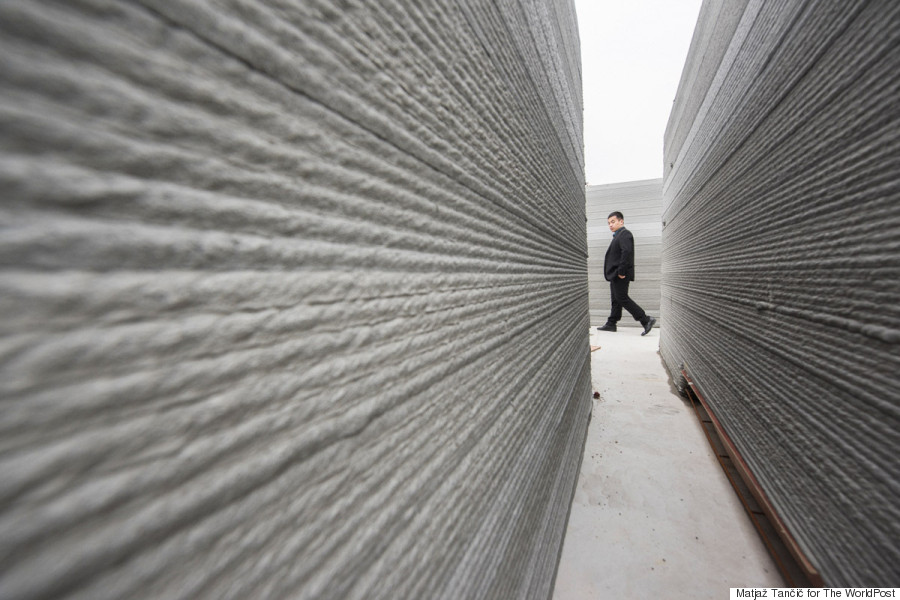 Those concerns haven't held back WinSun, and the company's first-mover status has brought huge amounts of publicity. Khoshnevis and some experts in the field maintain that WinSun's structures aren't earthquake resistant, but in January the company's structures received the thumbs-up from the lead engineer at a major state-owned construction company. Ma claims that the companies' first structures already have people living in them. Those people are "very brave," according to Lei Yu a Harvard-educated architect who now conducts research and produces 3-D printers in Beijing. He argues that major problems exist in maintaining stability between printed layers in the event of an earthquake. 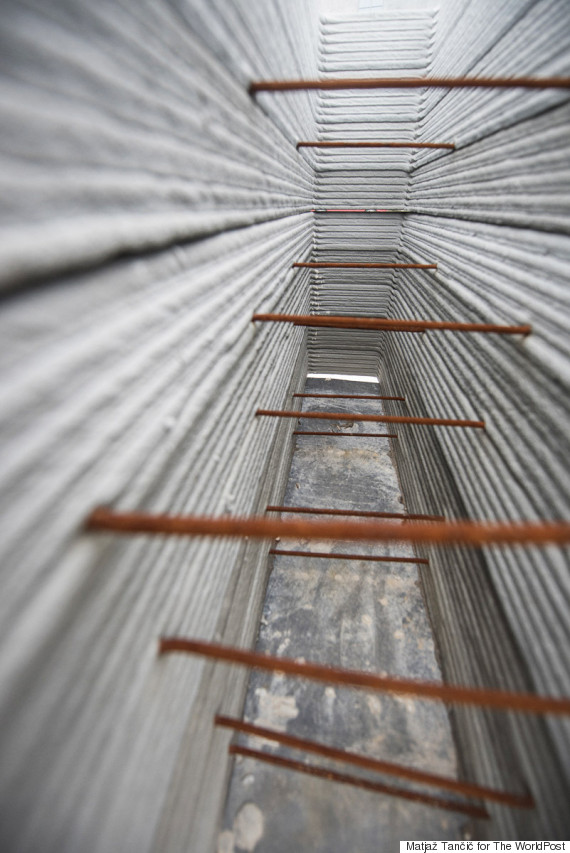 Yu has extensive experience in both architecture and cutting-edge 3-D printing, but he says for now the fields are tangentially related at best. While 3-D printing is helping architects build models to better conceptualize organic and non-linear structures, Yu and other architects say we'll likely see traditional homes put together by robots before we see 3-D printers popping out finished structures. In the meantime, both Khoshnevis and WinSun are forging ahead. Khoshnevis says he is now forming a company and acquiring the factory space that will allow Contour Crafting to finally produce finished structures. Ma claims he welcomes the competition. "We hope they'll produce something and give us an opportunity to learn," Ma said. "But so far we haven't seen it and he hasn't contacted us." -- This feed and its contents are the property of The Huffington Post, and use is subject to our terms. It may be used for personal consumption, but may not be distributed on a website. |
Canada's Supreme Court Rules Against Allowing Prayer At City Council Meetings
 TORONTO (RNS) Canada's Supreme Court has ruled that a small town in Quebec may not open its council meetings with prayer. TORONTO (RNS) Canada's Supreme Court has ruled that a small town in Quebec may not open its council meetings with prayer.In a unanimous ruling Wednesday (April 15), Canada's highest court ruled that the town of Saguenay can no longer publicly recite a Catholic prayer because it infringes on freedom of conscience and religion. The case dates back to 2007, when a resident of Saguenay complained about public prayer at City Hall. Just last year, a divided U.S. Supreme Court ruled that legislative bodies such as city councils could begin their meetings with prayer, even if it plainly favors a specific religion. But the Canadian high court ruled that the country's social mores have "given rise to a concept of neutrality according to which the state must not interfere in religion and beliefs. The state must instead remain neutral in this regard. This neutrality requires that the state neither favor nor hinder any particular belief, and the same holds true for non belief." The court said a nondenominational prayer is still religious in nature and would exclude nonbelievers. In 2011, a human rights tribunal in Quebec ordered an end to the prayers and awarded $30,000 in damages to the complainant. Quebec's Court of Appeals overturned that decision two years later, saying the town imposed no religious views on its citizens. But the high court ruled that it is the state's "duty to protect every person's freedom of conscience and religion." That means it "may not use its powers in such a way as to promote the participation of certain believers or non-believers in public life to the detriment of others." The court awarded the complainant $33,500 in damages. Only hours after the ruling was made public, the city of Ottawa suspended its practice of beginning council meetings with a prayer, saying it needs to review the decision. Other municipalities have also halted the practice, pending a review. |
Photographer Gets A Little Too Close To Lion, Escapes With This Stunning Picture
This is what it looks like to stare danger in the face.
Pakistani photographer Atif Saeed captured this incredible image of a lion at a wildlife park outside of Lahore by slowly creeping out of his car's open door. The 38-year-old told NDTV he sat on the ground, "a stone's throw" from the animal, and snapped a couple of photos, but was forced to retreat "within seconds" when the lion noticed him and leapt in his direction.  "The Ghost and the Darkness." "It was a pretty close encounter," Saeed conceded to ABC News. "I was laughing afterwards at the time, but I don't think I'd ever be able to do something like that again." Saeed retreated to his car, where we hope he locked the doors. Saeed took the photo in 2012, though it went viral earlier this month. Saeed shared the photo on Facebook in 2013, titling it "Angry king;" In January of this year, he shared it on 500px, calling it "The Ghost and the Darkness." |
Buckingham Palace Guard Slips On His Arse, Gives New Meaning To Royal Pain
It was like a Monty Python moment -- only it was real.
A Buckingham Palace guard slipped and fell during the famous Changing of the Guard last Thursday, giving hundreds of tourists a way more eventful photo op. We're amused. The Ministry of Defence? Maybe not so much. The Telegraph reported that the department would not comment on "a young man falling over while doing his job." So there.  H/T Pixable |
Clinton Foundation Will Limit Donations From Foreign Governments
 NEW YORK, April 15 (Reuters) - The Clinton Foundation will limit donations from foreign governments to six countries that already support it, in the wake of Hillary Clinton's decision to become a U.S. presidential candidate, the nonprofit charitable group said in a statement. NEW YORK, April 15 (Reuters) - The Clinton Foundation will limit donations from foreign governments to six countries that already support it, in the wake of Hillary Clinton's decision to become a U.S. presidential candidate, the nonprofit charitable group said in a statement.The countries are Australia, Canada, Germany, the Netherlands, Norway and the United Kingdom, which fund the foundation's work around the world on climate change and economic development, the statement said, citing a board decision. The foundation said it would disclose its donors more frequently, publishing the names of new contributors four times a year. Clinton stepped down from the foundation's board on Sunday when she announced she would seek the 2016 Democratic presidential nomination. (Reporting by Jonathan Allen: Editing by Peter Cooney) |
Langganan:
Postingan (Atom)


