
In Japan, the color red has varied meanings, depending on its shade. On the country's flag, a bold, red circle depicts the vivacity of the sun; on clothing and makeup worn by women beginning in the Heian period, a deep red dye made from safflower denoted rank.
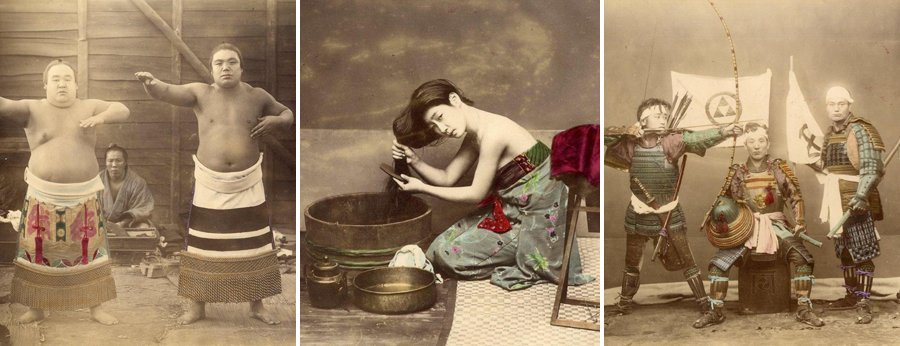 This crimson-like hue, along with other colors symbolic and not, was added with paint to photos taken in 1865 by Italian-British photographer Felice Beato. A prolific chronicler of the East, Beato was granted access to far-flung areas of Japan seldom seen by Westerners of his time. Though his earlier work in China has been characterized as imperialistic, his colorized pictures of samurai and courtesans from the Japanese Edo period have been lauded for capturing their subjects more honestly. In the below images, a long-haired woman gazes apprehensively at the camera while bathing; two sumo wrestlers pose in unison; a crew of proud samurai don blue uniforms. Beato's added shades of crimson and cherry give the viewer a fuller view of what the country was like just before Western infiltration. |
Japanese Samurai And Courtesans Brought To Life In Vivid, Colorized Photos
North Korea Defends Space Program, Developing New Satellite

| TOKYO (AP) — North Korean space agency officials say the country is developing a more advanced Earth observation satellite and are defending their right to conduct rocket launches whenever they see fit, despite protests by the United States and others that the launches are aimed primarily at honing military-use technologies. The North launched its first and only satellite in 2012. The claim that it is working on another, made in an interview last week with an AP Television crew in Pyongyang, comes amid a flurry of attention to the country's fledgling space agency, including a visit by leader Kim Jong Un to a new satellite control center that was repeatedly broadcast on North Korean TV early last month. "We are developing a more advanced Earth observation satellite and when it's complete, before launching it, we will inform international organizations and other countries," Paek Chang Ho, vice director of the scientific research and development department of the North's space agency, said in the interview. Paek did not provide further details of what the satellite will do, how close it is to completion, when development began or when the next launch might be. Speculation the North may be planning a rocket launch to mark the 70th anniversary this October of the ruling Korean Workers Party heated up after the release of recent satellite imagery at North Korea's Sohae rocket launch site. Analysts at the U.S.-Korea Institute at Johns Hopkins School of Advanced International Studies say the images show significant new construction. Concern has also been rising over North Korea's weapons development. The North recently claimed it tested a new type of missile from a submarine and reiterated that it had built a nuclear warhead small enough to be mounted on a long-range missile. Outside analysts are skeptical about both claims, but they believe the North has built a small but growing nuclear bomb arsenal and advanced its missile program since international nuclear disarmament talks stalled in early 2009. Paek, echoing the North's often-repeated public statements about its intentions, dismissed any linkage between the space program and weapons development. "Our National Aerospace Development Administration has peaceful objectives," he said. "America and its impure allies are always trying to persecute us ... We will continue launching satellites in the designated place when necessary and whether it is recognized or not. The high dignity of our republic will be exalted." The North was strongly criticized by Washington and subjected to tougher sanctions by the United Nations after the 2012 rocket launch carrying its first satellite. Most experts believe that launch did in fact place a satellite into orbit, though it's unclear whether the spacecraft was able to do anything beyond that. Opinion is divided over whether the North's primary goal was to bolster national pride with a high-profile technological achievement or, as Washington maintains, to move a step closer toward being able to field a long-range missile that could threaten U.S. cities. It could be a combination of both, as was the case with the United States and the Soviet Union during their own Cold War space race years. Either way, there is no doubt the North is actively promoting its space program to its people as a symbol of national accomplishment and prestige. Mock-ups, big and small, of the blue-and-white Unha-3 rocket launched three years ago are common in Pyongyang. Children climb on them in playgrounds; they are featured in amusement parks, assembly halls and even flower exhibitions. One of the catchiest tunes by North Korea's most popular singing group — the Moranbong Band — commemorated the launch as evidence of how the nation is single-mindedly roaring off into the future. "The eagerness of our people for space development and conquest is becoming the mainstream of the era and it cannot be dammed up," Paek said. Yun Chang Hyok, vice chief of the space agency's research institute, said North Korea is also looking into developing and launching a communications satellite, and sees weather satellites as potentially useful for agricultural forecasting and planning. He said Pyongyang believes investment in space technology is good policy, even in a country like the North that is strapped for resources, because its ripple effects through the economy bring "eightfold" benefits. "Outer space is becoming more of crucial part of people's lives," he said. "It is impossible to establish a powerful country without the development of space technology." |
Former FIFA Vice President Jack Warner Promises 'Avalanche' Of Secrets

| In a television address on Thursday, former FIFA vice president Jack Warner claimed to have substantial evidence of the soccer organization's alleged corruption. Speaking from his native Trinidad and Tobago, Warner, who for 21 years served as the president of CONCACAF, soccer's North and Central American governing body, said that he feared for his life, but was prepared to unleash all of his knowledge of FIFA's wrongdoings. "I will no longer keep secrets for them," he said, before adding, "I reasonably actually fear for my life." Last week, Warner and 13 other top FIFA officials were included in a 47-count indictment from the U.S. Department of Justice, and were subsequently arrested. While most of the Swiss-assisted, U.S.-led arrests happened near FIFA's headquarters in Zurich, Switzerland, Warner was arrested and released on bail in Trinidad. Warner claims that he was "afforded no due process," and continued to deny all charges. In 2011, he had stepped down as CONCACAF president amid bribery allegations. In his Thursday speech, which was broadcast as a paid political advertisement, he claimed to have financial evidence that would link FIFA officials with the 2010 Trinidad election, and that he would be handing it over to his lawyers. While he has yet to tangibly produce any of the evidence he alleges to have, Warner said that he possessed documents that "also deal with my knowledge of transactions at FIFA, including -- but not limited to -- its president, Mr. Sepp Blatter." "Not even death will stop the avalanche that is coming," Warner said. "The die is cast. There can be no turning back. Let the chips fall where they fall." Blatter, who resigned from the FIFA presidency just four days after being reelected to a fifth term, has yet to respond to Warner's allegations. Warner's stunning address came hours after Chuck Blazer, an ex-FIFA official, saw his 2013 guilty plea released. In those court documents, Blazer admits to bribery in connection with the 1998 and 2010 World Cup bids. On Wednesday, Interpol added Warner and five other FIFA officials to their most wanted list, issuing an international "red notice" on the men for charges of racketeering and corruption. If Warner tries to leave Trinidad, the Interpol alert puts him at risk for arrest anywhere he travels. |
Top UN Myths About Sex Abuse in the Central African Republic
 Context: In April 2015 Anders Kompass, an experienced human rights officer at the UN Office of the High Commissioner for Human Rights (OHCHR), was suspended by the High Commissioner for three months. During this time, the UN is carrying out an investigation of the events surrounding his transmission in late July 2014 of a report containing multiple allegations of sex abuse of displaced children by French troops in the Central African Republic (CAR). In May the UN Dispute Tribunal ruled that Kompass' suspension was improper, and he returned to work. The internal investigation continues, but it has been so controversial that yesterday the Secretary General announced that he would convene an independent inquiry. Context: In April 2015 Anders Kompass, an experienced human rights officer at the UN Office of the High Commissioner for Human Rights (OHCHR), was suspended by the High Commissioner for three months. During this time, the UN is carrying out an investigation of the events surrounding his transmission in late July 2014 of a report containing multiple allegations of sex abuse of displaced children by French troops in the Central African Republic (CAR). In May the UN Dispute Tribunal ruled that Kompass' suspension was improper, and he returned to work. The internal investigation continues, but it has been so controversial that yesterday the Secretary General announced that he would convene an independent inquiry.Meanwhile, misinformation and disinformation continue to surround the Kompass episode. What follows is an effort to separate the fact from the fiction. Myth 1: The French troops were UN Peacekeeping troops. Fact 1: The troops implicated in the abuse were French troops -- the SANGARIS operation -- deployed to the CAR in response to UN Security Council Resolution 2127. They were under French command, and only French law enforcement had the jurisdiction to discipline them. Further, the French were accompanied in the CAR by military troops from Chad and Equatorial Guinea, and military personnel from these two countries were also implicated in sexual abuse of children in the CAR. Myth 2: The UN was therefore not responsible for the abuse. Fact 2: While the UN was not responsible for the abuse that had occurred before victims reported what had happened, the Office of the High Commissioner for Human Rights (OHCHR) was responsible for taking steps to report the abuse to the appropriate jurisdiction once the office had knowledge of the allegations and information sufficient to address them. The mandate of the OHCHR reads: The mandate includes preventing human rights violations, securing respect for all human rights, promoting international cooperation to protect human rights, coordinating related activities throughout the United Nations, and strengthening and streamlining the United Nations system in the field of human rights. In addition to its mandated responsibilities, the Office leads efforts to integrate a human rights approach within all work carried out by United Nations agencies. It is noteworthy that the first aspect of the OHCHR mandate is "preventing human rights violations...." Myth 3: Anders Kompass leaked the report of sex abuse to the French Mission in Geneva. Fact 3: As a senior official with the OHCHR, Anders Kompass transmitted the report formally and confidentially to the French Mission with a signed cover letter for purposes of official investigation (see paragraph 4). In return, he received a formal response expressing the appreciation of the French government for the report and an intention to act immediately. The French Mission responded to Kompass: Given the seriousness of the allegations and the need to check the reality, it was immediately decided to go to court which will decide on the action to be taken, including possible criminal prosecution. Moreover, a disciplinary command investigation was launched immediately, under the responsibility of the General Staff of the Armies. (Translated from French) Myth 4: Kompass violated UN protocols by disclosing the report to the responsible government without redacting victims' names and descriptions of suspects. Fact 4: Because Kompass did not leak the report but rather transmitted it through the Mission to French law enforcement (see above), it would have been senseless to redact names and identities. Kompass transmitted the report to the French government so that French law enforcement could investigate, and therefore the identities of victims and perpetrators were evidence to be used to advance the investigation. Myth 5: The United Nations (the OHCHR) is concerned about the disclosure of the report because its protocols were violated by the disclosure of victims' identities. Fact 5: The OHCHR has no clear protocols for addressing ongoing, immediate and serious sexual abuse of children, and this is precisely why Anders Kompass finds himself at the center of this firestorm. Nonetheless, he is a senior OHCHR official with 30 years of experience in the field of human rights reporting. In a situation like this, where crimes are committed against child victims, he had to use his best judgment about how to proceed. He reported the evidence, with first names and nicknames of the victims and identifying characteristics of the perpetrators, the location of the camp in question, and the character of the abuses to law enforcement through official channels. Appropriate protocols must be developed. Myth 6: The United Nations facilitated the French investigation. Fact 6: The OHCHR appears to have obstructed the French investigation. The Human Rights Officer responsible for the report informed her/his supervisors that he/she had been contacted by French police in early August 2014. The Office of Legal Affairs (OLA) at the OHCHR then informed the French investigators that the reporting official could not be interviewed but would respond to written questions, thus slowing the investigation. The Human Rights Officer reported in a statement to investigators that he/she heard nothing about the case between September 2014 and March 2015. French authorities were negotiating contact with the officer in November and December 2014, but he/she did not receive a list of questions to be answered from investigators until early March 2015. The questions came through OLA. At the same time, the Deputy High Commissioner asserted that he and the High Commissioner did not pursue the issue because they believed that the French were handling it (page 2 of statement, top). Myth 7: The oversight offices of the United Nations, which operate independently of each other as well as impartially, are conducting a legitimate investigation of Kompass to clarify his responsibilities and actions in this episode. Fact 7: Before information was gathered, the Ethics Office, the Chief of Staff of the Secretary General, the Deputy High Commissioner and the Under-Secretary for OIOS consulted each other to determine how to proceed against Kompass. Moreover, the Chief of Staff informed the Fifth Committee and the press that she believed Kompass to be guilty of breaching OHCHR protocols while the investigation -- which was launched collectively by putatively independent oversight offices -- was underway. Myth 8: In proceeding as they did, transmitting information from the interviews with abused children only internally at the OHCHR and UNICEF, the reporting officials acted responsibly and properly. Fact 8: As cited above, the first responsibility of an official of the OHCHR is to prevent human rights violations. According to Inter Press Service: The documents show that the U.N. Children's Fund (UNICEF) had evidence of abuse by the soldiers on May 19, 2014. Then, during a June 18 interview, a 13-year-old boy said he couldn't number all the times he'd been forced to perform oral sex on soldiers but the most recent had been between June 8 and 12, 2014 -- several weeks after the first UNICEF interview. Remaining Questions: Under the protocols in place for documenting and reporting sex abuse among soldiers deployed under a resolution of the UN Security Council, when reports involve the armed forces of a member state and information has been provided to two different UN entities:
|
Rescuers In China Right Capsized Ship, Search For Bodies Instead Of Survivors
 JIANLI, China (AP) — Disaster teams that have recovered 77 bodies from a capsized cruise ship in the Yangtze River finished righting the previously overturned vessel on Friday to quicken the search for more than 360 other victims still missing. JIANLI, China (AP) — Disaster teams that have recovered 77 bodies from a capsized cruise ship in the Yangtze River finished righting the previously overturned vessel on Friday to quicken the search for more than 360 other victims still missing.The operation started late Thursday to right the Eastern Star and shifted the focus from finding survivors from Monday night's sudden capsizing in a severe storm to retrieving bodies. State broadcaster CCTV announced Friday morning that the boat had been righted, and that teams would still try to lift the vessel even though the water inside it was weighing it down. Transport Ministry spokesman Xu Chengguang said earlier that the operation would involve divers putting steel bars underneath the ship, which would then be lifted by two 500-ton cranes. A huge net was placed near the cranes and another one a few meters (yards) downstream to catch any bodies. Two smaller cranes were also on site and boats were stopped from entering the area. Authorities say 14 people survived the disaster, some by jumping from the ship during the early moments and swimming or drifting ashore. Three of them were pulled by divers from air pockets inside the overturned hull Tuesday after rescuers heard yells for help coming from inside. Xu told a news conference that no further signs of life had been found and the chance of finding anyone else alive was "very slim." On Thursday, rescuers had cut three holes into the overturned hull in unsuccessful attempts to find more survivors. More than 200 divers have worked underwater in three shifts to search the ship's cabins one by one, state broadcaster CCTV said. Rescuers pulled out dozens of bodies Thursday which were taken to Jianli's Rongcheng Crematorium, in Hubei province, where relatives tried to identify them. Many of the more than 450 people on board the multi-decked, 251-foot (77-meter) -long Eastern Star were reported to be retirees taking in the scenic vistas of the Yangtze on a cruise from Nanjing to the southwestern city of Chongqing. "I can't imagine how terrifying it must have been for them," said farmer Wang Xun, who was among the crowd observing developments outside the crematorium. "Old people should be with their families and go peacefully, not like this." The capsize of the Eastern Star will likely become the country's deadliest boat disaster in seven decades, and Chinese authorities have launched a high-profile response that has included sending Premier Li Keqiang to the accident site, while tightly controlling media coverage. The Communist Party's Politburo Standing Committee, the country's highest power, convened a meeting and issued a directive for officials to step up efforts to control public opinion about the disaster response, while ordering them to both "understand the sorrow of the families" and "concretely preserve social stability." The survivors included the ship's captain and chief engineer, both of whom have been taken into police custody. Some relatives have questioned whether the captain should have brought the ship ashore at the first sign of a storm, and whether everything possible was done to ensure the safety of the passengers after the accident. They have demanded help from officials in Nanjing and Shanghai to travel to the site in unruly scenes that have drawn a heavy police response. Records from a maritime agency show the capsized ship was cited for safety violations two years ago. Authorities in Nanjing held the ship after it violated standards during a safety inspection campaign in 2013, according to a report on the city's Maritime Safety website, which didn't specify the violations. The shallow-draft boat, which was not designed to withstand winds as heavy as an ocean-going vessel can, overturned in what Chinese weather authorities have called a cyclone with winds up to 130 kilometers (80 miles) per hour. The sudden capsizing meant many passengers were unable to grab life jackets, Zhong Shoudao, president of the Chongqing Boat Design Institute, said Wednesday. Access to the accident site was blocked by police and paramilitary troops stationed along the Yangtze embankment. China's deadliest maritime disaster in recent decades was when the Dashun ferry caught fire and capsized off Shandong province in November 1999, killing about 280. The Eastern Star disaster could become China's deadliest boat accident since the sinking of the SS Kiangya off Shanghai in 1948, which is believed to have killed anywhere from 2,750 to nearly 4,000 people. ___ Watt reported from Beijing. Associated Press writers Jack Chang and Ian Mader and news assistant Yu Bing in Beijing, video journalist Helene Franchineau in Jianli, China, and Elaine Kurtenbach in Tokyo contributed to this report. |
Healthy Living - How to Pick Up Good Habits
 Most people want to develop good habits like doing yoga before work, eating breakfast and saying "hello" to the elderly neighbor they see each morning. However, intending to pick up such habits and actually performing them are two totally different stories. Sometimes it seems like bad habits, like smoking or eating sweets every day, are easier to keep. Most people want to develop good habits like doing yoga before work, eating breakfast and saying "hello" to the elderly neighbor they see each morning. However, intending to pick up such habits and actually performing them are two totally different stories. Sometimes it seems like bad habits, like smoking or eating sweets every day, are easier to keep. Fortunately, you can alter your behavior and integrate healthy lifestyle choices into your routine. Here are some tips for picking up good habits: Fit it Into Your Existing Schedule If your goal is to get up early every morning to jog, but you're a night person, you have an uphill battle ahead of you. Instead of forcing yourself into a new schedule, place your new habits into a pattern that already works for you. In the case of the night owl turned fitness guru, consider running after work instead of before it. Take a look at your current schedule and see where that new habit of yours will fit. Replace the Bad with the Good Some of the habits you want to end or change take up prime slots in your daily schedule. Make the most of that situation by switching them with good habits. For instance, if you like to eat a bowl of ice cream after dinner while watching TV, get rid of the extra sugar and eat healthy alternatives. Cut up an apple and dip it in peanut butter. Or, nom on homemade real-fruit popsicles -- you'll satisfy your sweet tooth, but in a way that won't spike your blood sugar and negatively affect your weight. Think of it this way: You're finding better ways to address a need. Most habits form because you needed something (a way to relax, for example). Your good habits can and should address those needs -- that way, you're more likely to stick to them and avoid sliding into your old ways. Choose Small Commitments Initially, taking on huge new habits is daunting and could cause you to fall off the wagon. For instance, waking up at 5 a.m. to run when you normally get up at 7 a.m. is a big undertaking. Start small. Commit to waking up earlier -- that's it. You may end up running anyway! Simplify Your Choices The more decisions you have to make in a day, the more tired you become mentally. That means that by the end of the day, you don't have the energy for decision-making. Being drained makes slipping into old, bad habits and avoiding working on new ones easier, so pare down your options. For example, only stock your apartment with healthy snacks. When you come home after work, you won't have the option to reach for sugary treats. Set Up Your Space for Success Your apartment is where you spend most of your time, and it's the most comfortable environment you occupy. For this reason, it can be your greatest ally or enemy. Make sure your apartment becomes the former by arranging your space around your new habit. Only store healthy food in the fridge, keep your blinds open so morning sunlight wakes you up or designate a spot for exercising. No matter what good habit you want to form, you can devise a way to ensure your apartment makes the process easier. Find a Friend Forming habits is easier when you have an accountability partner, someone who will kick you into gear. While not all habits are ideal for working with another person, many are. For instance, going to the gym, cooking healthy meals and saving money are all doable when you have a friend, roommate, or significant other who will try to do the same. Schedule check-ins in which you talk about your progress and motivate each other. Who knows, pumping up your friend may also boost your enthusiasm. Introducing good habits that benefit your life may be challenging, but it's doable. Use these tips to get your habit to stick. |
Healthy Living - Getting to Serenity: 10 Daily Habits for Inner Peace
 We all want serenity, that elusive state of calm that seems to belong solely to Tibetan monks and yoga instructors. People with serenity are better equipped to enjoy life. Their small problems remain small and don't become magnified into huge catastrophes. And when real crises arise, they react with steady, clear thinking. We all want serenity, that elusive state of calm that seems to belong solely to Tibetan monks and yoga instructors. People with serenity are better equipped to enjoy life. Their small problems remain small and don't become magnified into huge catastrophes. And when real crises arise, they react with steady, clear thinking. However, serenity isn't achieved without effort. Just as we need proper exercise habits to have healthy bodies, we need good mental habits to have peaceful minds. To that end, here are some daily habits to get you on your own path to serenity. 1. Give Thanks Continually. When your alarm goes off, before you even get out of bed, close your eyes and think about the ways in which you've been blessed. Consider the most basic gifts that you have: a job, good relationships, your home, your clothing, your health. Then continue to give thanks throughout the day. If someone lets you in their lane when you are driving, give thanks. When your paycheck is deposited into your account, give thanks. When your child comes home from school safely, give thanks. Make a point of acknowledging every good thing that happens to you. 2. As Soon As Your Mind Wanders Off in The Wrong Direction, Get It Back on Course. We know when we are getting mentally off course. We get irritated over minor things. We decide it's our job to correct other people's bad behavior. We obsess over past slights. These are all symptoms of the mind going down a path toward wrong thinking. Like a car that has shifted into a lane with on-coming traffic, our minds also can shift into the wrong lane. As soon as that happens, stop what you are doing. Walk away from the person who isn't acting properly. Then do whatever it is that helps you get your mind back on track. For me, it's reading something spiritual. For others, it may be listening to inspiring music or talking to a good friend. By re-directing your mind, you can more easily return to clear thinking. 3. Practice Acceptance. Practicing acceptance doesn't mean that you allow yourself to be treated poorly by others. It means that you accept others for who they are. If someone is a jerk or manipulative, that is who they are. It's your choice whether or not to spend time with them, but accept that you can't change them. Likewise, practicing acceptance doesn't mean that you don't try to improve your life. For instance, you may not like your current job or home. Accept your situation for what it is today. Do your best at your job, and make your home as beautiful as possible. Appreciate that you have work and a place to live. Then do what you can each day to get your dream job or home in the future. Acceptance isn't stagnation. Acceptance is understanding what you can and cannot change. 4. Be Kind To Others. There is no scenario in which being unkind to others will benefit you. So be careful how you operate. The ugly things that you say and do to other people may affect them, but those actions will poison you. If you are unhappy, take a long, hard look at your behavior. If you spew mean comments or take advantage of people, you will be miserable. I can't sugarcoat that. Instead, be consistently kind. Build others up. Be helpful. You will find that by doing those three things, you'll be at peace with yourself because you will actually like yourself. 5. Be Careful What You Drink. Some things we drink can affect our minds. Coffee, tea and some soft drinks have caffeine. Caffeine affects each person differently. Evaluate how it affects you. If it makes you jumpy or irritable, then either reduce your consumption or eliminate it altogether. Alcohol affects people differently as well. If drinking wine, beer or hard liquor makes you anxious or depressed, again, limit your drinking or cut alcohol out of your life altogether. Being happy is more important than your Starbucks or your nightly glass of wine. 6. Get Enough Sleep. Our minds cannot think clearly if they aren't rested. Small children need copious amounts of sleep in order to be happy. Adults are no different. While we may not throw ourselves on the floor and scream if we haven't had a nap, we function only slightly better without sleep. Develop good sleep habits. Go to bed early. There is nothing wrong with going to bed at 9 p.m. The television shows you are missing aren't nearly as important as your serenity. 7. Watch and Read the Right Kind of Books, Movies and Television. What we watch and read affects how we think. Choose your entertainment carefully. There is a lot of violent, pointless junk out there which is deemed to be "avant-garde" or "creative." If you want to have a relaxed mind, spend your time watching and reading things that have a positive message or that educate. Don't spend your valuable free time filling your mind with garbage just because it's popular. 8. Keep a Clean, Uncluttered Home. There is a reason why spas don't have dirty towels on the floors and shelves covered with knickknacks. You can't relax in a place that is messy. A cluttered home or room is a sign of a cluttered or unstable mind. Make your home a place that is tidy and beautiful. You should breathe a sigh of relief when you enter your home. It should be a refuge for both your mind and your senses. 9. Spend Some Parts of the Day without Noise. There is nothing wrong with television per se, but there is something wrong with the television being on all the time. People tend to turn on the television to avoid being uncomfortable. We are either uncomfortable with our families, or we are uncomfortable with ourselves. So we distract ourselves from that discomfort with a lot of racket. The problem is that noise impedes you from truly relaxing. Make the choice to give your ears and mind a break, and enjoy the silence. 10. Spend Time with the Right Kind of People. There are people who can't help but be a problem. Everywhere they go, they create drama. Someone has always done them wrong, or they are continually upset about something. Or they just can't say anything nice. Give those people wide berth. You can't necessarily eliminate those people from your life, but you can limit your contact with them. It is a matter of self-preservation. When you allow people into your life who bring chaos, it is very hard to maintain your serenity. It isn't your job to make their lives better. It is their job to not spread their brand of drama. |
Healthy Living - Being a 'Morning Person' Can Help Keep You Healthy
 Early to bed, early to rise... Early to bed, early to rise... Back in grade school, Benjamin Franklin's old saying seemed like a sly attempt to get us to stop complaining about bedtime. But it turns out Ben was right -- at least about it making us healthy. If you're a "night person," this is going to be hard to hear. But a new study has found that night people are at higher risk for several unhealthy conditions. And this is true regardless of the number of hours they sleep. The study, conducted in Korea, looked at 1,620 participants between the ages of 47 and 59. They were identified as "morning chronotypes" (go to bed and get up early), "evening chronotypes" (go to bed later and get up later), or neither (people who fall somewhere in the middle and don't identify with either extreme). Then researchers compared the health of the morning and evening groups. They found that: • Female evening chronotypes tended to have more abdominal fat and an increased risk of metabolic syndrome (a condition associated with the development of cardiovascular disease and diabetes). • Male evening chronotypes overall had higher rates of diabetes and sarcopenia (a condition in which the body's muscle mass slowly declines). • Evening chronotypes, though typically younger than morning chronotypes, generally had a higher percentage of body fat and higher blood triglyceride levels. Even adjusting for age and lifestyle differences such as exercise, drug and alcohol consumption, and so on, the late risers were less healthy overall. So what's the takeaway? If you're a morning person, give yourself a pat on the back. If you aren't, try becoming one. Here are some strategies: • Decide a standard time you want to get up every day and start making yourself get up then. Set your alarm for that time, and don't hit the snooze button. Even on weekends don't sleep in too much. • Have a target bedtime as well. After a few days of getting up early, going to bed earlier will begin to feel more natural because your body will be tired. Tune into your body. (Incidentally, research suggests that going to bed by 10 p.m. is optimal because some of the best sleep happens between 10 and midnight.) • Turn off all electronic screens at least an hour before bedtime • Design a relaxing evening routine that gets you in the sleep mode. This might include dimming the lights and reading a print book in bed for half an hour. You might also drink a calming tea or take a warm bath. • Make your bedroom a tranquil place. Keep it clutter free, and get shades or curtains that effectively block the light at night. • Get out of bed quickly in the morning and start moving. A workout such as stretching, walking, or yoga will help wake and energize you. • Create a morning routine you enjoy and that sets you up for a good day. This could be a few minutes of meditation, keeping a gratitude journal, or even just drinking a cup of coffee while staring at a pleasant view. In general, all the things that support you to feel better during the day -- exercise, a healthy diet, a positive attitude -- help you to sleep better as well. If you're a night person, don't spend one minute feeling bad about it. Instead, just start playing with this pattern. At first, it might take discipline. But before long, having time to unwind in the evening and to get centered and energized in the morning might feel like a real treat. |
Alibaba Apologizes For Want Ad Seeking Candidates Who Resemble Porn Star
 Today, in questionable HR decisions: Today, in questionable HR decisions:Alibaba has apologized and pulled a job ad seeking a "programmer encouragement specialist." Requirements for the since-deleted position, as translated by Quartz, include an "adequately stunning" appearance and someone who might be an "open-minded lolita" like adult film star Sora Aoi or the South Korean actress Song Hye-kyo. The person in the position would be responsible for encouraging and inspiring programmers and engineers to do their best work, including waking them up for early morning meetings, the posting read. While the company promptly removed the ad, eagle-eyed readers grabbed a screenshot, which has reverberated around Twitter and the Chinese social media site Sina Weibo:
The e-commerce giant told Bloomberg the description intended to be humorous. It has since reposted an amended listing that removes references to Sora Aoi and encourages both male and female candidates to apply. "We apologize to anyone offended by this ad," a company representative told Bloomberg. "Alibaba is committed to providing equal opportunity and fair treatment to all employees on the basis of merit, without discrimination." |
Nepal Earthquake Death Toll Passes 7,000
 PAUWATHOK, Nepal (AP) — At the entrance of this destroyed mountain village, a wooden sign stands, cobbled together from debris of homes flattened by Nepal's devastating earthquake. Its message: "WE NEED HELP. PLEASE HELP." PAUWATHOK, Nepal (AP) — At the entrance of this destroyed mountain village, a wooden sign stands, cobbled together from debris of homes flattened by Nepal's devastating earthquake. Its message: "WE NEED HELP. PLEASE HELP."A steep winding road leads up to the ruins of the small village of Pauwathok, perched on a ridge about 3,600 feet (1,100 meters) above sea level. It's just 30 miles (50 kilometers) east of Kathmandu, Nepal's capital. But villagers say not one government official, not one soldier has visited since the massive quake struck a week ago, underscoring just how unprepared and overwhelmed Nepal's government has been. Early Saturday, a convoy of covered trucks approached Pauwathok. The trucks were apparently transporting aid and escorted by Nepalese police carrying automatic weapons. Hungry residents ran toward the road. The trucks were not stopping. "Are we invisible to you?!" a voice among the crowd screamed as the trucks rode slowly up a hill and out of sight. One week after the strongest tremor to hit impoverished Nepal in eight decades, aid has been slow in reaching those who need it most. In many places it has not come at all. U.N. humanitarian officials said Saturday they are increasingly worried about the spread of disease. They said more helicopters are needed to reach isolated mountain villages like Pauwathok, which were hard to access even before the quake. The true extent of the damage from the magnitude-7.8 earthquake is still unknown as reports keep filtering in from remote areas, some of which remain entirely cut off. The U.N. has estimated the quake affected 8.1 million people — more than a quarter of Nepal's 28 million people. The government's latest number, reported Sunday, is 7,040 dead, with little hope of finding survivors. Nepal has been shaken by more than 70 aftershocks, and its people remain on edge. One brief aftershock Sunday afternoon shook this village's only paved road, triggering screams from residents who began to run, then stopped when the tremor eased. Pauwathok is located in the district of Sindupalchok, where more deaths have been recorded than anywhere else in Nepal — 2,560, compared to 1,622 in Kathmandu. The U.N. says up to 90 percent of the houses in Sindupalchok have been destroyed. Rajaram Giri said he was sitting under a large tree when the big quake hit April 25. Pauwakthok was immediately engulfed in clouds of red dust. When it cleared, Giri saw only ruins. Only a handful of the village's roughly 80 homes remain habitable. Mostly made of brick and mud and sticks, they were either completely leveled or damaged beyond repair. Some families now sleep under makeshift shelters of debris that they constructed from their own ruined homes — torn roofs and boards, whatever was left. Others sleep under tarpaulins — obtained only after residents sat in the middle of the road Friday and blocked an aid convoy that eventually relinquished 30 of them, said Giri, who took one for his family. "We only have the clothes on our backs," he said. "The rest has been buried under the rubble." Volunteers have begun stepping into the void. Late Saturday, Pauwathok's appeal for help was finally answered. A truck full of rice, noodles and medical supplies pulled up. Everyone crowded round. The truck had been organized by a teacher who went for help to Kathmandu, where he collected donations from charities and friends. They brought the aid themselves. "The government has not been able to cater to the needs of everyone, so it's better if everybody can pitch in," said Supral Raj Joshi, who helped bring the aid. "It's not that the government isn't trying, it's that they've not been able to reach everywhere." Six other civilians, several of whom worked with street kids in Kathmandu, also came to deliver medical aid Saturday. They dressed the wound of an elderly lady, Tilamaya Bharti, who had lost part of a finger when a stone crushed it during the tremor. They also gave Bharti painkillers — the first she'd had since doctors in a nearby town conducted a hasty amputation last week and sent her away with nothing to ease the pain. While the situation in Pauwathok is grave, some remote parts of Nepal appear to have suffered even more. David O'Neill of U.K. International Search and Rescue said a team from his group had driven as far as it could, then walked for hours into six remote villages to assess them. The team reported that the villages had been so badly hit, 80 percent of their inhabitants had died. "Everything has been flattened," O'Neill said. The people there apparently died not in the original quake, but in a major aftershock the next day, he said. O'Neill spoke in Chautara, a destroyed town in Sindhupalchok. His team had hoped to reach the remote areas by helicopter, but none were available, so they were returning to Kathmandu. "We definitely need more helicopters," Ertharin Cousin, executive director of the U.N.'s World Food Program, told The Associated Press in the village of Majuwa, west of the capital. Aid agencies have been using Majuwa as a staging ground to get supplies deeper into mountainous areas. "This is one of the poorest places on Earth," Cousin said. "If the global community walks away, the people of this country will not receive the assistance that is required for them to rebuild their lives." That need remains great. Nepal Information Minister Minendra Rijal said the government has supplied only 29,000 tents to 400,000 displaced people. "The earthquake has caused unimaginable destruction," said Rownak Khan, a U.N. Children's Fund senior official in Nepal. "Hospitals are overflowing, water is scarce, bodies are still buried under the rubble and people are still sleeping in the open. This is a perfect breeding ground for disease." Medicine, medical equipment, tents and water supplies are needed now, he said. "We have a small window of time to put in place measures that will keep earthquake-affected children safe from infectious disease outbreaks - a danger that would be exacerbated by the wet and muddy conditions brought on with the rains," Khan said. Laxi Dhakal, a Nepal Home Ministry official, said hopes of finding survivors had faded. "Unless they were caught in an air pocket, there is not much possibility," he said. In Jalkeni, a village not far from Pauwathok, the road is lined with mounds of broken wood and stone, the remains of destroyed homes. On top of one mound sat a woman cradling a young girl. The mound — surrounded by a pile of dusty rocks, a broken TV and shredded clothes — used to be Sunita Shrestha's two-story home. "No one has come to help us yet," said Shrestha, as the sun beat down. "I don't know if they ever will." ___ Associated Press writers Binaj Gurubacharya in Kathmandu and Katy Daigle in Majuwa, Nepal, contributed to this report. |
Langganan:
Komentar (Atom)


